Peter Thiel’s Hidden Network Just Got Exposed

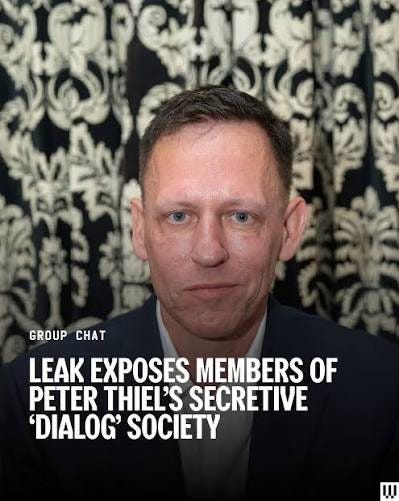
Peter Thiel’s Secret Society Was Never Supposed to Be Public
These days we’re drowning in conspiracy theories. The wellness world has them. The biohacking world has them. The business world has them. The political world has them. Every week there’s a new theory about secret cabals, hidden agendas, and shadowy figures supposedly controlling society from behind the scenes.
But who needs conspiracy theories when wealthy and powerful people are often doing what wealthy and powerful people have always done: building exclusive networks, cultivating influence, gaining access to decision-makers, and shaping the institutions that affect the rest of us. They don’t need secret tunnels under pizza parlors. They have private conferences, investment firms, political donations, lobbying networks, think tanks, media platforms, and invitation-only gatherings where ordinary people aren’t invited.
For twenty years, Peter Thiel and his associates built something most Americans had never heard of. It had no meaningful public profile. It published no membership roster. It held invitation-only gatherings where billionaires, technology executives, military leaders, intelligence figures, diplomats, politicians, and academics met behind closed doors under rules designed to keep discussions off the record. The organization was called Dialog, and until this week, the public knew almost nothing about who attended, what was discussed, or how extensive its network had become.
That changed when a massive data leak exposed membership records, planning documents, contact information, event schedules, and internal details about the organization. According to reporting from Wired and Straight Arrow News, the leak revealed a network that reaches deep into some of the most powerful institutions in American life. What emerged was not evidence of a criminal conspiracy. It was something more familiar and, in many ways, more troubling: a glimpse into how power increasingly operates in the twenty-first century.
The most important fact about Peter Thiel is not that he is a billionaire. America has lots of billionaires. It is not that he founded companies. America has lots of founders. What makes Thiel different is that he has spent years openly questioning the value of democratic governance itself. In a 2009 essay for the Cato Institute, Thiel wrote that he no longer believed “freedom and democracy are compatible.” Most people treated the statement as an intellectual provocation. Others dismissed it as the eccentric opinion of a wealthy Silicon Valley investor. Yet over the years, that sentence has become difficult to separate from the institutions Thiel has funded, the candidates he has elevated, and the networks he has helped build.
Dialog appears to fit neatly within that worldview. Democracy depends on transparency. Citizens cannot hold powerful people accountable if they do not know who is meeting with whom, who has access to decision-makers, or how influence moves between government and private industry. Yet the leaked records reportedly show senior government officials, military leaders, lawmakers, investors, intelligence figures, technology executives, and business leaders gathering in a setting deliberately insulated from public scrutiny. The issue is not that influential people were talking to one another. The issue is that some of the most powerful people in society were doing so within a private structure that was largely invisible to the public whose lives their decisions affect.
The attendee lists reportedly include government officials responsible for regulating industries sitting alongside executives from those same industries. Military and intelligence leaders appear alongside defense contractors and technology companies seeking government business. Venture capitalists appear alongside elected officials. Again, none of this proves wrongdoing. It does not need to. Democracies establish disclosure requirements, ethics rules, lobbying regulations, public records laws, and transparency measures precisely because citizens are supposed to know when power is being concentrated. The concern is not necessarily corruption. The concern is that the public has no meaningful way to evaluate whether corruption exists when the relationships themselves are hidden.
The leaked agenda for an upcoming Dialog gathering in Ireland only reinforced the sense that participants viewed themselves as something more than attendees at a networking conference. Sessions reportedly included discussions on artificial intelligence, warfare, battlefield technologies, political movements, and the future of society. One session was called “Build-a-Party.” Another was called “Build-a-Cult.” Defenders will undoubtedly argue that these titles were meant playfully. Perhaps they were. But there is something difficult to ignore about an elite gathering founded by a billionaire who has publicly questioned democracy hosting a session literally titled “Build-a-Cult.” At a minimum, it reveals a remarkable lack of awareness about how such a gathering appears from the outside.
What makes this story especially significant is that it arrives during a period when Silicon Valley billionaires have become increasingly comfortable exercising direct political power. For decades, wealthy industrialists largely operated behind the scenes. Today’s technology elite often view themselves not merely as business leaders but as architects of society. They fund political candidates, shape media ecosystems, influence foreign policy debates, build surveillance technologies, invest in artificial intelligence systems, and increasingly speak as though democratic institutions are obstacles to progress rather than safeguards against concentrated power. Thiel has been among the most influential figures in that movement. His backing helped launch the political careers of major Republican figures. His company Palantir became deeply embedded in government, intelligence, military, and law enforcement operations. His intellectual influence extends far beyond Silicon Valley boardrooms.
Viewed through that lens, Dialog begins to look less like a private club and more like a manifestation of a broader ideology. It reflects a belief that society should be shaped by a relatively small group of exceptionally wealthy, exceptionally connected, and exceptionally powerful people who see themselves as better equipped than the public to make consequential decisions. The language may differ. The justifications may be more sophisticated. But the underlying assumption remains remarkably old: that a select few should guide the many.
The irony is that many of the people involved would likely reject that characterization. They would argue that they are simply exchanging ideas, building relationships, and discussing important issues. They may even be right. Yet the leak raises a question they have never adequately answered. If these conversations are benign, why was so much effort devoted to keeping them hidden? Why was there no public membership list? Why no transparency about attendance? Why build an organization that operated for two decades without meaningful public visibility while attracting some of the most powerful people in government, technology, finance, and national security?
Those questions matter because democracy is not sustained by elections alone. It survives through public accountability. Citizens must be able to see how power is organized, who has access to it, and how decisions are shaped before they reach the public sphere. The Dialog leak matters because it pulled back the curtain on a world that was never intended to be seen. For twenty years, an influential network of political leaders, military officials, technology executives, investors, and policy makers met largely beyond public view. The leak did not create that reality. It simply exposed it.
The most revealing part of the story is not that Dialog existed. The most revealing part is that its participants appeared to assume they would never have to explain its existence to the public. That assumption says far more about how today’s elite view accountability than any leaked membership directory ever could.
Thanks for reading. This Substack runs on readers like you, not corporations or billionaires, but people who care about seeing clearly in a noisy world. I write this as an Iranian immigrant and a healthcare worker who has seen firsthand what happens when bad ideas get institutional power.
Subscribe to my Substack so you don’t miss what’s coming next. Free takes 10 seconds. Paid keeps this independent. Share it and comment either way.
The more people reading this, the louder we get. Thank you for being here 🙋🏻♀️
I love your point about how we don’t need conspiracy theories when the reality is far more insidious. I’m curious how elected officials and those running for office will address this leak.